A Little Perspective On What Happened:
According to a 2021 survey by Limeade, there were 6 million fewer resignations in 2020 than in 2019 when the pandemic hit and the United States shut down. Putting that number into perspective, that is 16,438 fewer resignations PER DAY than the previous year. That sounds pretty good, doesn’t it? You might think the Great Resignation was short-lived, and now things are gradually getting back to normal. You would be wrong.
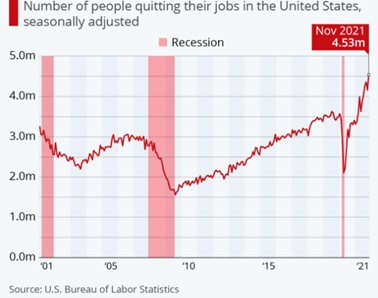
An estimated 19 million workers resigned between March 2021 and July 2021. Again, doing the math, that is 12,418 per day. Was it better, sure. Was it still very, very bad… oh yeah! From March of 2020 through the end of 2021, 47 MILLION Americans left their jobs (Zippia.com). In short, the Great Resignation continues…
Many of these workers were in roles considered “essential”. Healthcare workers who bore the brunt of the pandemic. I cannot say enough about the sacrifices made by our healthcare workers. We should be very thankful for all they do – every day – not just during a pandemic. It is not surprising that the majority of burnout and retirements came from this group of essential and hard to replace individuals. Of course, anyone in the hospitality and entertainment industries took a hit. Many were willing to work, but their employers were forced to shut down for the good of the public. While everyone can understand the need to protect others, if you were one of those impacted, you could be forgiven for feeling like you were being singled-out.
Resignations by Industry
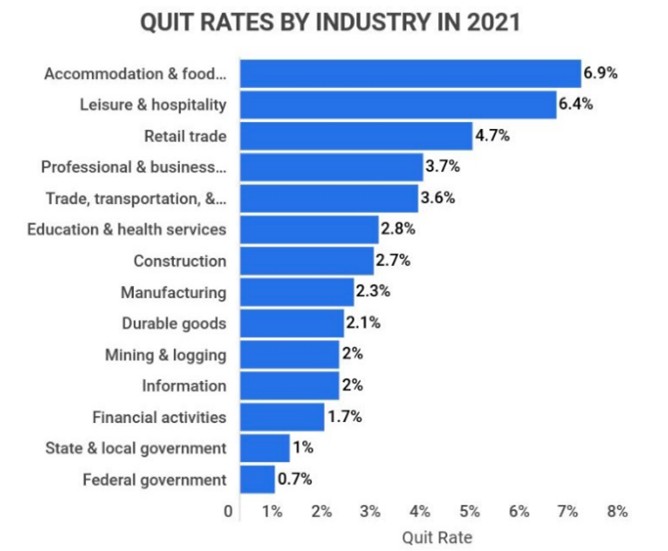
But as anyone reading this article knows, the Great Resignation did not just impact a few select industries. Just about every industry was impacted. In many industries, the people resigning cannot be easily replaced. You can’t just walk in off the streets and become an air traffic controller. It takes YEARS of very specific and formalized training. Shorten that certification requirement and you put millions at risk. We lost engineers, doctors and other medical staff. . Consultants with 30 or more years of experience. Investors and those who help shape our economy. Scientists and those who will come up with the next vaccine.
We lost tens of thousands of teachers – another group whose contributions are way under appreciated. Teachers shape the generations to come. But in several states, the requirements to teach have been dropped substantially. In Florida, for example, the governor has suggested that they will now allow military veterans, retired law enforcement, paramedics and firefighters to become teachers. All they need is a bachelor’s degree. While I am the first to support any reasonable program that helps our veterans and first responders find and keep roles in the private sector,
there are some very important learning experiences required before you just walk into a classroom of unruly children. Just because you save lives, that does not mean you know how to create and deliver a curriculum, deal with pre-pubescent teens, or their parents! We lost truck drivers, thousands of them. At a time when the supply chain has been decimated. Just about every voice mail for every company begins with the phrase, “we are experiencing longer than normal response times…” Of course, that is just the beginning. The entire “customer experience” has been reshaped. Everyone is looking to hire, and it seems there are just not enough qualified people available.
So why did this happen? Was it “caused” by the pandemic? Or was the pandemic simply an accelerator of issues and conditions that were already starting to rise to the surface?
Organizational Change – The Biggest Contributor to Resignation
About 28% of the workforce resigned without another job lined up. This is a significant data point. If you resign without another role in mind, the issues leading to the resignation must have been pretty significant. But almost two-thirds of those resigning did not leave out of desperation, burn out, or an unwillingness to want to work any longer (early retirement). More than 72% of the workforce left for reasons that might have been avoided if employers were paying attention to some key factors.
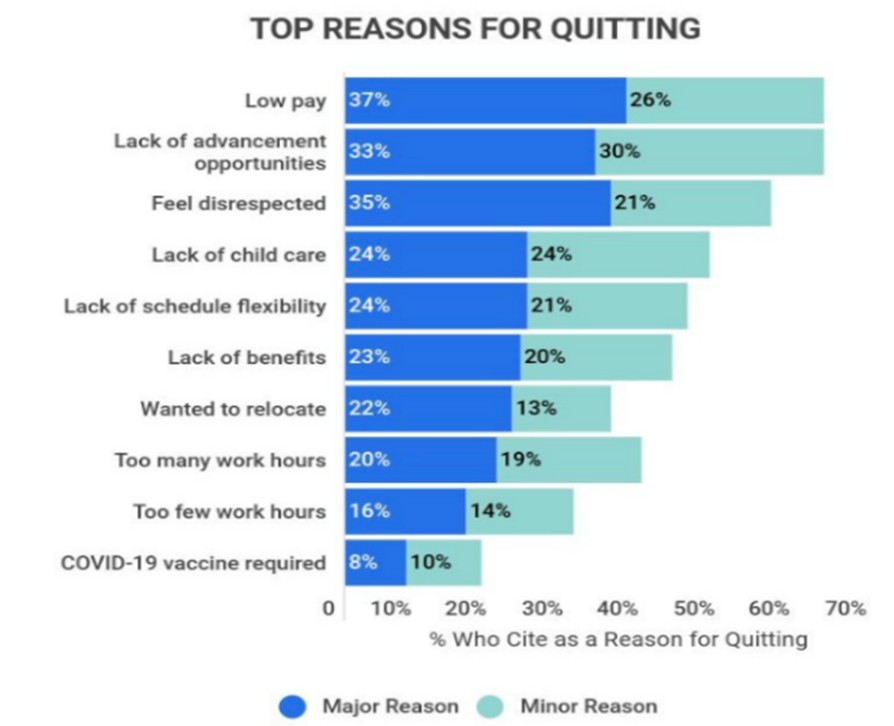
A little over one third of those resigning left due to “organizational change”. The company responded to the pandemic in ways that had significant impact on them, but they felt they had little, if any, input. Change was forced upon them and they reacted.
Communications – or a lack thereof:
Organizational change in and of itself probably did not drive people to leave. It was the total lack of communications around the reasons for the change that drove them to look elsewhere. Millions of jobs might have been retained if the employers had been more forthcoming in their responses. Instead of fear, the employee might have been willing to work with the employer to modify their role, move into a new role, improve their performance in another area, work a few more hours per week, work a different shift, or anyone of a number of other options that did not include resignation.
Millions of employees worked their entire careers inside an office building. Then, in one day, they were “forced” to work from home. Many did not have a home office. Many had to work from their kitchen table while home schooling their children. They dealt with angry or frustrated customers with a dog barking in the background. Many of them did not have access to the systems, data, reports and other supporting infrastructure they needed to perform their duties. In some cases, things as simple as a lack of printers or scanners made their jobs so much harder to complete.
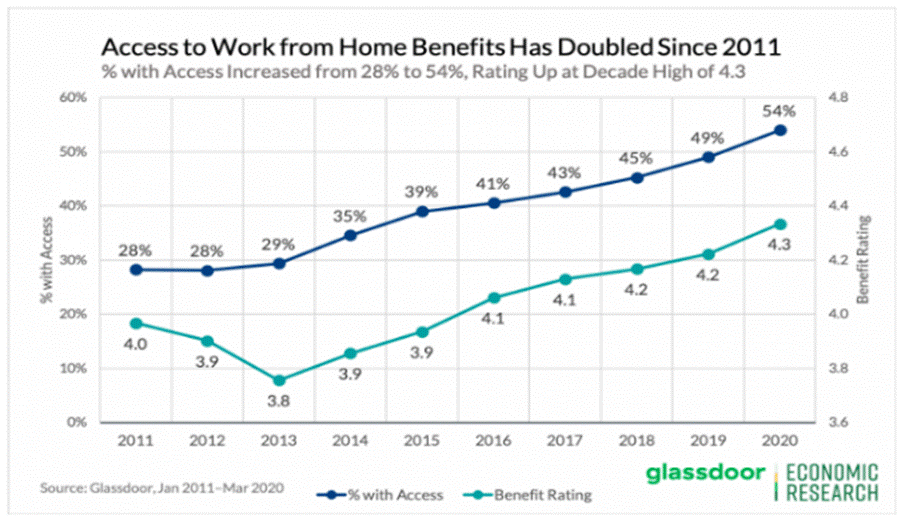
Many of these employees spent their entire career within a “company family”. They celebrated birthdays, they watched as their colleagues got married, divorced, had babies, paid for college, paid off their mortgages, etc. And now they are working alone. Without any kind of organized support systems and very little guidance and/or support from their company. Is it any wonder they left?
What might have happened if the company had taken steps, right away, to reach out to their people (their work family) to ensure they were surviving all of this organizational change? In a report by the CDC in June of 2020, 40% of all U.S. adults reported struggling with mental or substance abuse. This seems impossible – until you watch the nightly news reports.
According to a recent survey by Akumina, the “State of the Digital Workplace & Modern Intranet” demonstrates that many workers will remain remote in 2023 and beyond. Companies are “empowering their workers to make their own decisions”. But the caveat to all this is the fact that many employees have to take a reduction in pay if they work from home. Most have to make a firm decision. They can’t “try it” for a while because their employer is significantly reducing the square footage in the office. They simply don’t have a cubicle to go back to. Mixed signals are being sent. And part-time workers took a huge hit. There are as many as 20% fewer part-time roles available in 2022 from 2019. That is a huge decrease in a short period of time (Glassdoor).
Simple Ways to Improve Retention
Twenty percent of employees suggest that they left because their input was not valued. They were trying to help their employer survive! They were trying to remain viable and productive. But the employer was not willing to communicate with them. They had no forum they could use.
Did you know that the “employee suggestion box” was started by the Japanese in 1721? And yet now, 300 years later, less than 3% of American companies have effective suggestion programs (Source: National Association of Suggestion Systems). USA Today found that less than 38% of all working men and women feel that their managers are willing to listen to new ideas.
According to a Gallup research study, each idea offered by a “less than engaged” employee can save the company up to $4,000 on average. Ideas from ‘highly engaged” workers can save the company $11,000 on average. Honestly, how can you afford NOT to listen to your workers? That is where the institutional knowledge resides. This is another example of the breakdown in communications.
Our work family is hurting. As employers, it is our duty to take steps to engage our workers, audit their emotional state, offer assistance, and come up with creative ways to help our family overcome this forced isolation that was thrust upon them. Isolation they may still be feeling. But coming up with creative solutions is actually one of the biggest issues leading to the Great Resignation in the first place!
Working Remotely – The Truth:
Employees working remotely are not lazy or taking advantage of the company. In fact, they work MORE hours and accomplish more work each day. They follow up better with the customers.
According to an insurance industry survey, the average commute time for the U.S. worker is just under 30 minutes. Working remotes gives employees an additional hour of potential productivity without costing the employer one single penny.
There's an App for That!
Did you know that there are apps that track employee productivity? Insightful has a remote employee monitoring and time tracking solution that provides employers “Simple, accurate time tracking and proof of work to ensure they’re doing the job you hired them to do.” According to Fannie Mae, 62% of people surveyed say that remote productivity is better than office productivity. 51% say operating costs have decreased. But 52% say that employee collaboration has also decreased. Stanford University undertook a two-year study. The hypothesis was that over time, the average workers productivity would equalize. That was not the case and results were “staggering”:
- Remote workers worked their entire shift. The elimination of commuting was the largest contributor to this statistic. But remote workers also take shorter breaks – because there isn’t anyone to socialize with. They have fewer sick days. They took less time off.
- Remote workers are “far less distracted” then in the office. They concentrated better and for longer periods of time. Their productivity rose as a result. What was most significant in the study was that remote workers seemed to actually like their work MORE. Employee attrition decreased by 50% for those workers in the study! The reason was that remote employees felt more autonomy and/or empowerment. Micromanagement was significantly less. They made their own decisions and (take note) those decisions were good ones!
- Less stress – EVENTUALLY. Over time the people in the study did learn to accept and flourish working “alone”. Some studies have indicated that the biggest cause of depression, anxiety, substance abuse and suicides was the lack of an outlet outside of work. Going out to dinner with friends. Going to a movie. Seeing family over the holidays. It was the isolation outside of work, not the isolation at work. But when you are distressed, you may not be able to tell the difference. This is where a concerned employer could help.
"The mass exodus workplaces have experienced over the past several months is unprecedented — burnout levels reached an all-time high. There was a societal breakdown when it came to the ecosystem of work, home and well-being. People reached their limits."
Dr. Laura Hamill, Limeade Chief Science Advisor
The quote above puts it all into perspective. During the pandemic, employers in every industry fought the idea of allowing employees to work from home. Even when they had no choice due to pandemic shut downs, they still conveyed a “lack of trust” culture into the organization.
Companies were also very slow to recognize the stress, fear and loneliness being felt by employees. People spend more of their waking hours with their work colleagues than they do with their own families! Having their support systems pulled out from under them, in some cases overnight, was something that employers should have realized and worked to minimize. The Stanford University study closes with this comment:
“Remote work does come with its own challenges – challenges you can overcome by creating a culture of open and transparent communication.”
Regardless of the challenges, remote work is here to stay. So, learning to communicate effectively is now a requirement, not an option.
Penny Wise and Pound Foolish:

Economists have a word for it. The “Composition Effect”. It refers to changes in data that are driven by a shift in underlying characteristics. In the case of the pandemic, there was a tremendous number of lower-paid workers losing or resigning from their jobs while higher paid employees, managers and executives remain on the job. In April 2020, the US Bureau of Labor Statistics reported that year-over-year growth in hourly earnings “skyrocketed” by 8%. This gave everyone a very incorrect idea of the state of the workforce.
People were not receiving raises; it was simply that the “average” wage increased due to an artificial (and devastating) reduction of low paid workers. Employers were slow to figure out that their employees were working harder, longer and in some cases taking significant risks – for no significant improvement in their current situation. In fact, as an “average” they LOST ground! Employers did not notice, but the employees sure did.
Cost of Attrition
How much does it cost when you lose an employee? Obviously, this is highly dependent upon the barriers to entry for the role. But almost one-third of people moving to a new role did so for an increase of 10-19%. If the employee made $50,000 per year, they left for what amounted to a $5,000 per YEAR raise. $417 per month. About $2.50 per hour!!! When you consider the institutional knowledge you lost, the impact on the customers (that annoying message again), the mistakes made by new employees, it seems crazy that employers were willing to lose MILLIONS of trained and productive employees for what amounts to a small increase in their compensation. Small increase to the company, HUGE statement to the employee. In this case it was not what you said or did. It was what you didn’t say or do. A little acknowledgement and a little consideration go a long way. But instead of acting proactively, many employers followed their existing HR policies. Policies that were created in a much different time for a much different world.
Many companies suggest that their HR salary surveys clearly defined the pay ranges they are willing to consider. They have ranges and they fight hard to stay within these ranges no matter what. The pay scale is not arbitrary. It applies to all employees at all levels. It is “supported” by data. If the company were to give one person a raise, they would have to give everyone a raise. This type of thinking was clearly unacceptable. And the employees demonstrated that with their feet. Nearly 30% of all people leaving for a new role cite “compensation” as their key driver. At a time when just about every company is looking to hire, and qualified employees are hard to find, the employee had all the leverage. In example after example, employees left one company and had a new role the next day! The $2.50 per hour increase in the current compensation was a “no brainer” for them. They got all your good employees. You know the ones I’m talking about… the ones that knew how to get things done.
Employers were simply not paying attention. They chose to consider their employees as “taking advantage of the situation”. “Holding the company hostage”. They might have even thought that the employees were lying about being able to find a new job willing to pay them more. Obviously, that was not the case. If only their current employer were willing to give them some well-earned recognition during a time when recognition was everything! If only the current employer were willing to be just a little more flexible.
Lack of Flexibility, Inclusion and Creative Thinking:
A huge number of job changers (40%) cite a lack of flexibility as the reason they looked for “greener pastures”. But what does that mean?
The lack of flexibility was so dramatic that 13% of all those changing jobs did so while taking a pay CUT! 23% moved for the same amount as they made in the previous job. This 36% moved because they felt that their employer was unwilling to listen to them, work with them, value them or CARE FOR THEM. Employers missed out on a great opportunity. The chance to really shine. They could have been an example of a company doing all the right things to keep their best people. And most likely benefitting tremendously as a result. What a great opportunity to demonstrate your willingness to drive real change. Demonstrate your true feelings for your corporate family. Demonstrate the things that were really important. Never mind that you would most likely get exponentially higher returns on the $2.50 per hour increase to your employees.
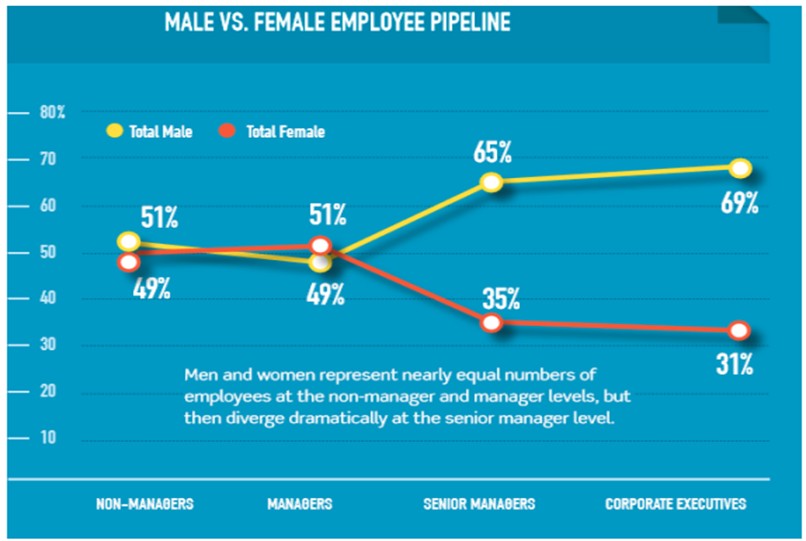
Employees are hurting and they need to feel that their employer is listening. This is especially true for the historically underappreciated. Acknowledging and promoting “Women in the Workforce” is a HUGE movement right now. As an employer, if you are not addressing this, you will continue to see exceptional people leave your company. Creating a “women in software”, “women in trucking”, or “women in construction” group is something that every company should be addressing. Whatever your industry or specialty, you need to create a forum for women to come together and drive their message. And… you need to listen to what they are telling you. A focus on women is good business.
Gender Differences
Let’s face it, women have:
- Better problem-solving skills. (Harvard Business Review)
- Superior soft skills. Women outperform men in 11 of 12 key emotional intelligence competencies (U.S. Department of Labor)
- Greater financial gains. Companies with women in top leadership roles saw greater financial gain than those dominated exclusively by men. Companies in the top quartile for gender diversity were 15% more likely to outperform their competitors! (McKinsey & Company)
- Women empower women. Let’s face it, men have had their “good-ole-boy” networks for generations. Research from the Harvard Business Review found that women who had a “female-dominated inner circle” of one to three women landed leadership roles that were 2.5 times higher in authority and pay than those of the female peers lacking this combination.
So, What Can We Do?
In a word, “care”. The definition of care is “looking after and providing for the needs of someone or something”. It seems like such an obvious and simple thing. Oh, if only that were true.
Listening to employees, allowing them to give feedback, forming groups where they can get together and talk about the issues and opportunities before them, being more attuned to the stresses their job places on them, trusting them – especially when they are not physically in the building, asking them what they need, and acting on their responses, formalizing the employee evaluation process – and promoting groups to positions of responsibility, publishing their victories, promoting women and minorities – for the benefit of your company… It’s a long list but the results of a commitment to, and a focus on, employee health and well being can be a huge advantage for your company. At a time when employees continue to resign by the millions, finding, cultivating, growing, promoting and KEEPING key employees is an essential competitive advantage.
Companies continue to invest and lose billions of dollars on hiring, training, and then rehiring and retraining. It is simply good business to break this cycle.